The Nobel Prize in Physics 2015 was awarded jointly to Takaaki Kajita and Arthur B. McDonald "for the discovery of neutrino oscillations, which shows that neutrinos have mass"
 |
| Experiments probing the secrets of neutrinos, including at the Super-Kamiokande detector in Japan (shown), earned the 2015 Nobel Prize in physics. | KAMIOKA OBSERVATORY/INSTITUTE FOR COSMIC RAY RESEARCH/UNIV. OF TOKYO |
The scientists led two sophisticated experiments that found that the elusive particles can morph from one variety into another — a phenomenon that can occur only if neutrinos have mass. The discovery delivered a jolt to particle physics because prevailing theories had predicted that neutrinos were massless.
Physicists knew there are three types of neutrinos: muon, electron and tau. But in 1998, Kajita and his team at the Super-Kamiokande experiment found evidence that neutrinos produced in Earth’s atmosphere switched identities before striking the detector, located under a Japanese mountain. Three years later, McDonald’s Sudbury Neutrino Observatory collaboration discovered that some neutrinos emitted by the sun change flavors en route to Earth.
Today physicists around the world are working to identify the particles’ exact masses and understand neutrinos’ importance throughout the history of the universe.
 |
| Photographs of Takaaki Kajita, left, and Arthur B. McDonald were displayed at a news conference in Stockholm on Tuesday to announce that they had been awarded the Nobel Prize in Physics. Credit Jonathan Nackstrand/Agence France-Presse — Getty Images |
Takaaki Kajita of the University of Tokyo and Arthur B. McDonald of Queen’s University in Canada were awarded the Nobel Prize in Physics on Tuesday for discovering that the ghostly, elusive subatomic particles known as neutrinos have mass-"for the discovery of neutrino oscillations, which shows that neutrinos have mass."“At this moment in this room there are more than a billion neutrinos, which travel almost at the speed of light.”
The Nobel Committee said the discovery -- arcane to nonscientists -- has changed our understanding of matter, and may yet change our view of the universe.
"The Nobel Prize in Physics 2015 recognizes Takaaki Kajita in Japan and Arthur B. McDonald in Canada, for their key contributions to the experiments which demonstrated that neutrinos change identities," the Nobel Committee's statement said. "This metamorphosis requires that neutrinos have mass. The discovery has changed our understanding of the innermost workings of matter and can prove crucial to our view of the universe."
A neutrino is "an elementary particle which holds no electrical charge, travels at nearly the speed of light, and passes through ordinary matter with virtually no interaction," according to the physics.about.com website.
Scientists say that neutrinos, because they interact weakly with other particles, can probe environments that other kinds of energy, such as light or radio waves, cannot penetrate.
The discovery has changed our understanding of the innermost workings of matter and can prove crucial to our view of the universe.
The discovery rewarded with this year’s Nobel Prize in Physics have yielded crucial insights into the all but hidden world of neutrinos. After photons, the particles of light, neutrinos are the most numerous in the entire cosmos. The Earth is constantly bombarded by them.
Many neutrinos are created in reactions between cosmic radiation and the Earth’s atmosphere. Others are produced in nuclear reactions inside the Sun. Thousands of billions of neutrinos are streaming through our bodies each second.Neutrino means ”small neutral one” in Italian.
Press release "Metamorphosis in the particle world": http://goo.gl/jRi8jy
Last year's Nobel winners in physics were two scientists in Japan and one at the University of California, Santa Barbara for helping create the LED light, a transformational and ubiquitous source that now lights up everything from our living rooms to our flashlights to our smart phones.
Since 1901, the committee has handed out the Nobel Prize in Physics 108 times. The youngest recipient was Lawrence Bragg, who won in 1915 at the age of 25. The oldest physics laureate was Raymond Davis Jr., who was 88 years old when he was awarded the prize in 2002.
Neutrinos are the second most abundant subatomic particles in the universe, after photons, which carry light. Their existence was predicted in 1930, but for decades, they remained some of the most enigmatic elements of astrophysics.
The academy said the two men won the prize for their contributions to experiments demonstrating that neutrinos change identities.
The metamorphosis requires that neutrinos have mass, the academy said, adding that the discovery has changed our understanding of the innermost workings of matter.
 |
| The "Super-Kamiokande" neutrino detector operated by the University of Tokyo's Institute for Cosmic Ray Research helped scientist Takaaki Kajita win a share of the Nobel Prize in Physics, along with Canadian Arthur B. McDonald. | Kyodo /Landov |
"Around the turn of the millennium, Takaaki Kajita presented the discovery that neutrinos from the atmosphere switch between two identities on their way to the Super-Kamiokande detector in Japan.
"Meanwhile, the research group in Canada led by Arthur B. McDonald could demonstrate that the neutrinos from the Sun were not disappearing on their way to Earth. Instead they were captured with a different identity when arriving to the Sudbury Neutrino Observatory."
 |
| This May 2010 photo shows Takaaki Kajita of Japan, director of the Institute for Cosmic Ray Research and professor at the University of Tokyo. (Kyodo News/Associated Press) |
 |
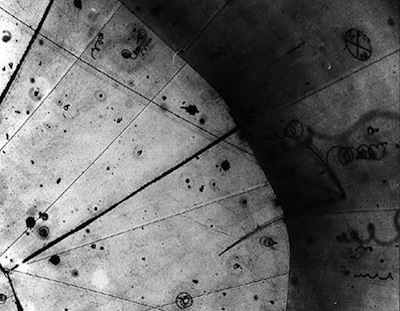
| The world's first neutrino observation in a hydrogen bubble chamber was found Nov. 13, 1970, on this historical photograph from the Zero Gradient Synchrotron's 12-foot bubble chamber. The invisible neutrino strikes a proton where three particle tracks originate (right). The neutrino turns into a muon, the long center track. The short track is the proton. The third track is a pi-meson created by the collision. (Argonne National Laboratory/Wikimedia Commons) |
There are three kinds of neutrinos. Electron-neutrinos, mu-neutrinos and tau-neutrinos. This year’s prize is awarded to the experimental discovery that neutrinos can change identity. For example, a mu-neutrino can become a tau-neutrino and vice versa. They oscillate.
The observations were made by two research groups, one at the Super-Kamiokande detector in Japan and the other at Sudbury Neutrino Observatory in Canada. The discovery implies that neutrinos, which were believed to be massless, do have a mass, even if very little. And since there are so many of them, it changes our view of the universe.
Dr. Kajita was part of a team of researchers who in 1998 announced that they had found the existence of mass in the notoriously mysterious particles. The neutrino — it means “small neutral one” in Italian — carries no electric charge and is so light that it had been assumed for many years to have no mass at all.
I
n 1999, Dr. McDonald announced that the first neutrinos had been captured by a uniquely sensitive new detector 6,800 feet below ground, at the Sudbury Neutrino Observatory, which is part of Queen’s University in Kingston, Ontario.
The scientists showed that neutrinos, which are found in three “flavors,” could oscillate from one flavor to another, demonstrating that they do not lack mass.
The universe is swamped in neutrinos that are left over from the Big Bang, and many more are created in nuclear reactions on earth and in the thermonuclear reactions that power the sun.
Once thought to be massless and to travel at the speed of light, they drift through the earth and our own bodies like moonlight through a window. Knowing that they can change identities means that they have mass, and that has helped cosmologists understand how the universe has evolved and how the sun works and perhaps will help them improve their attempts to create fusion reactors on earth.
Dr. Kajita and Dr. McDonald will share 8 million Swedish kronor, or about $960,000. They joined 199 laureates, including Albert Einstein, Niels Bohr and Marie Curie, who have been honored with the prize since 1901.
The announcement of the prize was made in Stockholm by Goran K. Hansson, permanent secretary of the Royal Swedish Academy of Sciences, which appoints the prize committee.
Arthur "Art" Bruce McDonald, FRSC is a Canadian physicist and the Director of Sudbury Neutrino Observatory Institute. He also holds Gordon and Patricia Gray Chair in Particle Astrophysics at Queen's University in Kingston.Ontario.
Born: August 29, 1943 (age 72), Sydney, Canada
Residence: Kingston, Canada
Fields: Astrophysics
Education: California Institute of Technology, Dalhousie University
Awards: Benjamin Franklin Medal, Benjamin Franklin Medal
 |
| Scientist Arthur McDonald, of Kingston, Ont. is seen here in April 2008, when he was invested as Officer to the Order of Canada. On Tuesday, McDonald was announced as a co-winner of the 2015 Nobel Prize for physics. (Fred Chartrand/Canadian Press) |
Born in Sydney, N.S. in 1943, McDonald earned Bachelor's and Master's degrees from Dalhousie University. He got his Ph.D. in physics from California Institute of Technology in 1969.
He worked for Atomic Energy of Canada from the late 1960s until 1982, when he moved to Princeton University for seven years.
He has been at Queen's since 1989 and has been a professor emeritus since 2013.
McDonald was invested as an Officer of the Order of Canada in 2008.
The late Willard S. Boyle of Nova Scotia was the only previous Canadian winner in physics, one of four to be honoured in 2009.
Scientists operating huge underground detectors in Japan and Canada are racing to obtain independent proofs that the elusive neutrino, a ghostly particle whose vast family may constitute a large part of the mass of the universe, changes form as it flies through matter or space.
At least some neutrinos are now believed to have some mass, and physicists would love to learn how much, a goal that may be reached by studying the changes in form a traveling neutrino undergoes.
At issue is the effect of neutrinos, which pervade every cubic inch of the universe, on the rate at which the universe expands. Physicists also hope that further neutrino discoveries will account for the Sun's ''missing neutrinos,'' neutrinos predicted by theory but not yet detected by observation.
The chameleons of space
Torn between identities – tau-, electron- or myon-neutrino
MORE INFORMATION for INTERESTED!!!!!
The hunt was on – deep inside the Earth in
gigantic facilities where thousands of artificial
eyes waited for the right moment to uncover
the secrets of neutrinos. In 1998, Takaaki Kajita
presented the discovery that neutrinos seem to
undergo metamorphosis; they switch identities
on their way to the Super-Kamiokande detector
in Japan. The neutrinos captured there are
created in reactions between cosmic rays and the
Earth’s atmosphere.
Meanwhile, on the other side of the globe, scientists at the Sudbury Neutrino Observatory in Canada, SNO,
were studying neutrinos coming from the Sun. In 2001, the research group led by Arthur B. McDonald
proved that these neutrinos, too, switch identities.
Today, the 2015 #NobelPrize in Physics was announced - to Japanese Takaaki Kajita and Canadian Arthur B. McDonald!
A year ago at an international meeting at Takayama, Japan, a Japanese-American team of physicists disclosed the first clear evidence that neutrinos oscillate from one ''flavor'' to another as they pass through Earth. The discovery, made with the help of a cathedral-size underground water tank called Super Kamiokande near the city of Kamioka, Japan, may shed light not only on neutrinos but on the future expansion rate and behavior of galaxies and the universe.
In the past year physicists in North America, Europe and Japan have been racing each other to find independent evidence confirming or refuting the finding of neutrino oscillation, and several large laboratories have left the starting gate in the quest.
The existence of neutrinos was predicted in 1930 and the particles were actually discovered in 1956, but they remain cloaked in enigmas. Physicists have determined that in particle reactions, separate neutrino types are associated with three other types of lepton particles: electrons, muons and tau particles. Thus, electron neutrinos (the kind emitted by the Sun's nuclear reactions), muon neutrinos (produced by laboratory accelerators) and tau electrons (known by inference but never directly detected) interact with matter in different ways.
Any experimental investigation of neutrinos is extraordinarily difficult because these particles have no electric charge and their mass, if not zero, must be vanishingly small. This means that a typical neutrino could pass through a six-trillion-mile thickness of solid lead with only a negligible chance of hitting anything.
Fortunately for scientists, however, an occasional neutrino defies the astronomical odds and hits a bit of matter in some detector -- a tank of water, an atom of air or a huge block of Antarctic ice, for example -- yielding a shower of debris. Some of the debris leaves trails of blue light as it streaks through transparent objects or fluids. Measurements of this light, called Cherenkov radiation, allows scientists to reconstruct the events that caused it.
Experiments under way promise to shed light on the neutrino's apparent ability to transform itself into different forms, a phenomenon that could explain why the Sun's nuclear furnace seems to emit many fewer neutrinos than the process should produce. It may simply be that the solar neutrinos are reaching Earth in the predicted numbers, but that many of them have turned themselves into forms that are not revealed using conventional detectors.
On June 9 scientists announced that the first neutrinos had been captured by a uniquely sensitive new detector at the Sudbury Neutrino Observatory, known by the acronym SNO, 6,800 feet below ground in the Creighton nickel mine near Sudbury, Ontario.
Like other large neutrino detectors, SNO mainly consists of a huge water tank. What gives it greater sensitivity for corralling neutrinos than any similar detector is that in place of ordinary water, it is filled with 10,000 metric tons of heavy water, water in which each ordinary hydrogen atom with a lone proton in its nucleus is replaced by a hydrogen isotope, called a deuteron, containing a proton and a neutron.
Unlike ordinary water, which can snag only one ''flavor,'' or type of neutrino, heavy water is sensitive to all three neutrino flavors: electron, muon and tau. In theory, heavy water should register the arrival of all three flavors with equal probability, regardless of how they try to hide by oscillating from one flavor to another.
Building SNO took 15 years, and its heavy water alone, lent for the experiment by Atomic Energy of Canada Ltd., is valued at $210 million. There were many delaying snags along the way, and yet it took only a few days to begin seeing the first neutrinos after the detector was inaugurated in April, say the Canadian, American and British scientists who built it.
Dr. Arthur B. McDonald, the director of the observatory, said in his announcement on June 9 that ''to see such clear examples of neutrino interactions within days of finally turning on was a real triumph for the entire SNO team.''
Dr. Eugene Beier of the University of Pennsylvania, a spokesman for the United States contingent of the multinational observatory team, said it would probably take about two years before the detector yielded ''definitive'' evidence of having spotted all three neutrino flavors.
Meanwhile, the detector may have to be modified to improve its sensitivity. In one experiment, magnesium chloride would be mixed with the heavy water, because chloride is particularly effective in capturing neutrons emitted by neutrino interactions. In another modification, detectors containing the rare isotope helium-3 would be added to the water tank; helium-3 offers neutrons an even fatter target.
At stake is a hoped-for confirmation that neutrinos in flight oscillate between flavors. Under the rules of quantum mechanics, this implies that neutrinos have mass, a situation with enormous implications for astrophysics and cosmology because neutrino mass could affect the rate of expansion of the universe and influence the formation of galaxies and large-scale structure in the universe.
Two new developments in Japan are narrowing the search for confirmation of neutrino oscillation.
In a paper to be published next week, a large Japanese and American team reports the discovery of a nonsymmetric effect in the arrival of neutrinos at the Super Kamiokande detector. More neutrinos were found hitting the detector from the western direction than from the east, an effect predicted from Earth's magnetic field.
Neutrinos themselves are not influenced by magnetic fields, but in this case they were created by the annihilation of positively charged cosmic ray particles drawn toward Earth by the planet's geomagnetic field. Neutrinos created by the impact of cosmic-ray particles on upper atmospheric atoms continue along roughly the same trajectories as the original cosmic rays.
The asymmetric east-west neutrino result came as no great surprise to the experimenters, ''but it was an extremely important result,'' Dr. Beier said, ''because it showed by independent means that the measurements of neutrino flow reported in Japan last year were made correctly.''
Another important neutrino experiment making use of a powerful proton accelerator in Japan is expected to begin in a few days, said Dr. Lawrence R. Sulak of Boston University, a member of the Super Kamiokande research team.
In the experiment, a proton beam from Japan's KEK (a Japanese acronym meaning High Energy Accelerator Research Organization) is to be fired into an aluminum target producing an intense beam of pi-meson particles, which decay rapidly into neutrinos and muon particles. The resulting neutrino beam will first pass through a nearby water detector and then hit the ground at a downward angle of 1.5 degrees, re-emerging 155 miles to the west at the Super Kamiokande detector. (The experiment is known as K2K, for KEK to Kamiokande.)
The 155 miles of Earth through which the beam passes offers no appreciable barrier to the neutrinos. If the same neutrino flux is found at the nearby detector as at the distant Kamiokande detector, the experiment will offer no proof of oscillation. But if, as expected, fewer neutrinos are found at the end of the line than at the beginning, it will mean that detectable neutrinos have transformed themselves into an undetectable form on their way through Earth's crust.
Meanwhile, somewhat similar experiments are planned in Europe, where a beam of neutrinos from the Fermi National Accelerator Laboratory near Chicago will slice through Earth to a neutrino detector 460 miles away in an iron mine near Duluth, Minn.
In a third project, a neutrino beam from the European Laboratory for Particle Physics (CERN) near Geneva would be directed through the ground to detectors within the Gran Sasso Tunnel under the Italian Alps 455 miles away.
''Many experiments are closing in on the neutrino from many different angles,'' Dr. Sulak said. ''With luck, it won't be too long before we penetrate the particle's secrets.''
Photos: The vessel above holds heavy water at the the Sudbury Neutrino Observatory, 6,800 feet deep in a Canadian nickel mine, whose access shaft is shown at upper right. A filtration system, lower right, purifies heavy water.(Photographs by Bob Chambers/Sudbury Neutrino Observatory)(pg. F4)
Tiny, Plentiful and Really Hard to Catch
By KENNETH CHANGAPRIL 26, 2005
An hour north of Duluth, Minn., and a half-mile down, the dim tunnels of the Soudan mine open up to a bright, comfortably warm cavern roughly the size of a gymnasium, 45 feet high, 50 feet wide, 270 feet long.
Well hidden from the lakes, pine forests and small towns of northern Minnesota, the mine churned out almost pure iron ore until it closed in 1962. Today, it is a state park, and it houses a $55 million particle physics experiment that is part of a worldwide effort to unravel the secrets of the neutrino, one of the least known and most common elementary particles.
Because of discoveries over the past decade, the ubiquitous neutrino, once a curiosity in a corner of particle physics, now has the potential to disrupt much of what physicists think they know about the subatomic world. It may hold a key to understanding the creation of hydrogen, helium and other light elements minutes after the Big Bang and to how dying stars explode.
The experiment at Soudan will measure the rate that neutrinos seemingly magically change their types, giving physicists a better idea of the minute mass they carry. An experiment at Fermilab outside Chicago is looking for a particle called a "sterile neutrino" that never interacts with the rest of the universe except through gravity.
Astrophysicists are building neutrino observatories in Antarctica and the Mediterranean, which will provide new views of the cosmos, illuminating the violent happenings at the centers of galaxies, distant bright quasars and elsewhere.
The particle is nothing if not elusive. In 1987, astronomers counted 19 neutrinos from an explosion of a star in the nearby Large Magellanic Cloud, 19 out of the billion trillion trillion trillion trillion neutrinos that flew from the supernova. The observation confirmed the basic understanding that supernovas are set off by the gravitational collapse of stars, but there were not enough data to discern much about the neutrinos.
The much larger detectors in operation today, Super-Kamiokande in Japan, filled with 12.5 million gallons of water, and the Sudbury Neutrino Observatory in Canada, would capture thousands of neutrinos from a similar outburst.
Because neutrinos are so aloof, successful experiments must have either a lot of neutrinos, produced en masse by accelerators or nuclear reactors, or a lot of matter for neutrinos to run into. Given the cost of building huge detectors, scientists are now turning to places where nature will cooperate.
In Antarctica, the IceCube project will consist of 80 strings holding 4,800 detectors in the ice, turning a cubic kilometer of ice into a neutrino telescope. Fourteen European laboratories are collaborating on a project called Antares that will similarly turn a section of the Mediterranean off the French Riviera into a neutrino detector.
The Soudan experiment takes the other approach, using bountiful bursts of neutrinos generated by a particle accelerator. Shoehorned into the back of the underground cavern is a detector of modest size, a mere 6,000 tons, consisting of 486 octagonal steel plates standing upright like a loaf of bread. Each plate, 1 inch thick and 30 feet wide, weighs 12 tons.
On a visit to the cavern last month, William H. Miller, the laboratory manager, pointed at the far rock wall. "Fermilab, that way," he said. This experiment is intended to catch just a few of the neutrinos created at Fermilab, 450 miles away, which gush out of the rock wall, through the cavern, through the steel plates and then through another several miles of rock before emerging out of the earth and continuing into outer space, having no effect on Dr. Miller or the reporter interviewing him.
Only occasionally, a neutrino runs into a proton or neutron among the many atoms in the steel plates, and the wreckage of that collision is recorded as tiny bursts of light careering through the detector.
When the experiment begins running at full speed later this year, Fermilab will send trillions of neutrinos every couple of seconds flying toward Soudan. The beam will spread out to half a mile wide by the time it reaches Minnesota, so most of the neutrinos will miss the cavern entirely. But even among those that strike the bull's-eye, only one every few hours will actually hit something in the detector and be detected.
So far, in the testing phase in the past two months, the Soudan detector has seen just three, maybe four, neutrinos from Fermilab. But then, Wolfgang Pauli thought physicists would never see any. Pauli, a pioneer of quantum theory, contrived the notion of neutrinos in 1930 to explain the disappearance of energy when unstable atoms fell apart. Pauli said the missing energy was being carried away by an unseen particle.
Physicists later discovered that neutrinos come in three types, whimsically called flavors. The flavor seen first was the electron neutrino, which interacts only with electrons. Heavier electron like particles known as muons and tau particles are accompanied by their own flavors of neutrinos.
In 1998, an experiment at Super-Kamiokande showed that neutrinos change flavors as they travel along. For that to occur, the laws of physics dictate that the neutrinos, which had been thought be massless, must actually carry along a smidgen of weight, less than a millionth as much as an electron, the next lightest particle. Each flavor also has a slightly different mass.
In the Fermilab-to-Soudan experiment, the neutrinos are generated from a beam of protons, which are directed down a newly built $125 million tunnel, focused to a very narrow width with powerful electric fields and then slammed into a piece of graphite. That produces short-lived particles called pions, which in turn generate muon neutrinos as they decay.
The beam passes through a smaller version of the Soudan detector, allowing the physicists to verify the number of neutrinos. The tunnel, sloped downward three degrees, ends just beyond the detector. The neutrinos keep going, into the earth, to emerge in the Soudan cavern one four-hundredth of a second later.
By using neutrinos created in an accelerator, physicists will be able to vary the energy of the neutrinos and see how that changes the number detected at Soudan.
A decade ago scientists at Los Alamos National Laboratory in New Mexico looked at neutrinos traveling a short distance from a nuclear reactor and saw indications of a large oscillation, suggesting a relatively large mass gap between two of the neutrino flavors. The gap was large enough that it could not fit into any theory consisting of just three neutrinos. But other experiments showed that only three flavors of neutrinos that interact with ordinary matter exist.
That has led to speculations of a new class of particles called sterile neutrinos. These particles would exert a force on other matter through gravity but would otherwise be completely inert.
Dr. Kayser said most theorists "are skeptical, because it doesn't fit," yet no one can point to obvious flaws in the Los Alamos work, either. The new experiment at Fermilab, called MiniBooNE, is looking for the same effect but with a different setup, firing neutrinos into a spherical tank containing 250,000 gallons of baby oil.
The consequences may include the understanding of atom production in the aftermath of the Big Bang and in supernovas. Because
neutrinos are essential to the nuclear reactions that change protons to neutrons and vice versa, they influence which elements form in what relative proportions.
"
That would have profound implications for our models of the early universe and for supernovas," said Dr. George M. Fuller, a professor of physics at the University of California, San Diego. "It could change everything."
The problem is that current models that include three flavors of neutrinos do a good job of explaining the amount of hydrogen and helium in the universe. The existence of sterile neutrinos would send astrophysicists scurrying to come up with new calculations to produce the same answers.
On the other hand, current models of supernovas have trouble producing enough neutrons to form the heavier elements like uranium, and Dr. Fuller said sterile neutrinos could shift the reactions toward producing more neutrons.
Future experiments should aim at understanding other aspects of neutrinos, said Dr. Kayser, who was co-chairman of a committee that just released recommendations for future neutrino study.
For one, the neutrino oscillation findings say only that a difference in mass between the different flavors exists, but not the exact mass of any of them. The presumption is that because
an electron is lighter than a muon and a muon is lighter than a tau that the same pattern should be true of the three neutrino flavors, with the electron neutrino the lightest and the tau neutrino the heaviest. But that does not have to be the case.
Physicists are also trying to learn whether an antineutrino is actually a neutrino. (Other antiparticles have opposite electrical charge. Because neutrinos are electrically neutral, nothing would prevent a neutrino from being its own antiparticle.)
Another open question is whether neutrinos play a role in the imbalance of matter and antimatter. If the early universe had contained equal amounts of the both, everything would have been annihilated, leaving nothing behind to form stars and galaxies.
Among quarks, which form protons and neutrons, physicists have observed a subtle matter-antimatter imbalance, called CP violation, in the behavior of particles known as mesons. "That CP violation is completely inadequate to explain the universe that we see," Dr. Kayser said.
So physicists suspect that there must be CP violation elsewhere and that the oddity of neutrinos suggest they could be a source. That, in turn, leads to speculation of yet more new types of neutrinos -- very heavy ones that existed only in the very early universe -- and the decay of those heavy neutrinos created the preponderance of matter.
Neutrinos play a role in the mysterious dark energy that is pushing the universe apart or that neutrinos could be used for interstellar communication.
Ref--
http://www.nytimes.com/2015/10/07/science/nobel-prize-physics
http://www.cbc.ca/news/technology http://goo.gl/kuV8je
http://edition.cnn.com/2015
https://www.sciencenews.org